
Sanctity Amidst the Shadows: The Quiet Heroism of Family and Mikveh During the Holocaust

Updated: Apr 16
This year, the offical Yad Vashem ceremony for Yom HaShoah centers on the Jewish family during the Holocaust. Before the war, the Jewish family was a framework of stability, identity, and belonging. Under Nazi rule, however, countless families lost their ability to function almost overnight. Violence, deportations, and starvation reshaped family life, reversing roles and forcing even children to carry the burden of survival.
Yet even out of the destruction, the family remained a source of strength. In ghettos, hiding places, and camps, Jews sought human closeness to endure one more day. After the war, survivors searched for relatives and, when they could not be found, built new families, symbols of resilience and return to life. Despite devastating loss, the rebuilding of family became central to both personal healing and the rebirth of the Jewish people.
Family was a source of comfort, a place of solace. Even when torn apart, many held fast to the hope of rebuilding, drawing strength from one another and from the traditions that defined Jewish life.
Among the most intimate of these traditions were the laws of Taharat HaMishpacha (family purity) and the use of the mikveh. Historical records preserved at Yad Vashem¹ such as diaries, photographs, and rabbinic responsa, reveal the profound dilemmas faced by families and rabbinic leaders. Marriage, intimacy, and childbirth were no longer private matters, but questions of survival, danger, and halakhic complexity.
The Mikveh as Quiet Resistance

The Nazis actively worked to dismantle Jewish religious infrastructure. In December 1939, mikvaot in Warsaw were sealed, and their use declared an act of “sabotage,” punishable by imprisonment or death. Yet, as recorded by Rabbi Shimon Huberband, women continued to immerse in rivers and remote areas.² These acts, carried out in secrecy and danger, reflected a determination to preserve dignity and identity.
Halakhic Dilemmas Under Impossible Conditions
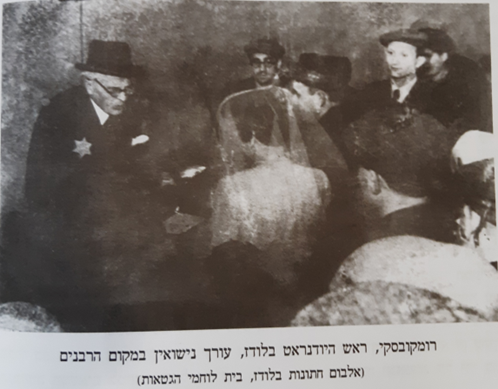
Rabbis in the ghettos debated whether marriages should even take place. On one hand, marriage provided emotional connection and dignity. On the other, it raised serious concerns. With mikvaot closed, couples could not properly observe Taharat HaMishpacha. There was also the risk of creating agunot (chained women) who would be unable to remarry if their husbands disappeared.

In Warsaw, Rabbi Yehoshua Moshe Aronson argued against performing weddings under such conditions, noting both the halakhic challenges and the brutal realities women faced.³ In other places, the response differed. In the Kovno Ghetto, under Rabbi Ephraim Oshry, rabbis permitted marriages despite the absence of a kosher mikveh. There, remaining unmarried could place women in immediate danger of execution. Faced with certain risk to life, marriage became a means of protection, reflecting the painful balance between halakhic ideals and survival.⁴
Personal Acts of Courage and Continuity
Alongside these communal decisions were deeply personal acts of courage.
For some, Taharat HaMishpacha was among the final legacies passed from parent to child. Judy Nuszen recalled how her mother, Yehudit, used their last moments together on a train to Auschwitz to teach her about the mitzvah of mikveh and entrusting her with the responsibility to carry it forward.⁵
In another account, a young woman, newly liberated from Auschwitz and completely alone, was engaged to marry. She describes learning about these laws for the first time in a most unusual way. A fellow survivor who had known her parents took it upon himself to teach her, carefully preserving her dignity by turning away as he spoke about delicate and intimate matters. Both cried as they learned together, bridging loss and continuity.⁶
Determined to rebuild, she later walked ten kilometers to reach a functioning mikveh. What she found was filthy—covered with algae and debris. Still, she immersed. For her, this act became the spiritual foundation of the family she would go on to build.
Courage in Everyday Observance
Acts of quiet heroism also took place even before deportations. In Nazi Germany, Bertha Klugmann from Frankfurt, connected to the community of Rabbi Samson Raphael Hirsch, risked her life each time she went to the mikveh. Walking at night, she would hide whenever she saw an SS officer, waiting until it was safe to continue. Step by step, there and back, she persisted each time she needed to immerse.⁷
Rebuilding After Destruction
These stories reveal that some of the most profound resistance during the Holocaust took place in the most private spheres of life. The commitment to Taharat HaMishpacha was not only about observance, it was about preserving identity, dignity, and hope.
After the war, this commitment became part of the rebuilding. Survivors did not only create new families, they restored the sanctity and values that define Jewish family life. The quiet dedication to these mitzvot helped lay the foundation for future generations.
While the Shoah is often remembered through destruction and loss, these stories highlight something else: resilience. The steadfastness of women and families, their belief in continuity, and their commitment to building anew (even from nothing) became a powerful force in the survival of the Jewish people.
Their heroism was not always visible. It lived in hidden journeys, whispered teachings, and acts carried out in fear and uncertainty. But it is precisely this quiet heroism that helped ensure that Jewish family life would endure.
In rebuilding intimacy, dignity, and connection, they did more than survive; they helped bring about renewal.
Footnotes
All historical materials and photographs referenced here were provided by Esther Rute and Shmuel Galandoer and used with permission from the International Institute for Holocaust Studies of Yad Vashem.
R. Shimon Huberband, Kiddush Hashem: Writings from the Holocaust from the Ringelblum Archive in the Warsaw Ghetto, pp. 89–92.
R. Yehoshua Moshe Aronson, Alei Merorot: Diaries, Responsa, and Thought During the Holocaust, 2nd ed. (Jerusalem: Mossad Harav Kook, 2013), pp. 230–231.
R. Ephraim Oshry, Mima’amakim (From the Depths), Vol. I (New York, 1962), Responsum 18, p. 111.
Judy Nuszen, as recounted by her granddaughter Rena Glazer.
Testimony from a personal letter to her grandchildren.
As recounted by her granddaughter Carolyn Karp.


